
Board Tabletop Exercise: How to Rehearse Decisions Before the Headlines
Run a board tabletop exercise that stress-tests decision rights, escalation, and comms, so you stay aligned when facts are thin and time is tight.


You don’t lose control in a crisis because your leaders are careless. You lose control because the moment arrives fast, facts are incomplete, and the decision system lacks resilience under pressure. People talk past each other. Authority gets fuzzy. Comms drift. The board gets surprised, not by the event itself, but by how long it takes to agree on what to do.
A board tabletop exercise is a guided, discussion-based walk-through of a high-stakes scenario (cybersecurity incident, AI failure, vendor outage, regulatory inquiry, reputational blowback) where directors and executives practice making governance-level calls. It’s not theater. It’s a rehearsal for oversight, risk management, escalation, risk thresholds, and external messaging when the clock is running.
If you’re the board chair, a member of executive leadership like the CEO, GC, or CISO, you want the same thing: calm, aligned decisions when it matters most. Below, you’ll learn what “good” looks like, how to run a board tabletop exercise step by step, and how to turn a strong session into real operating changes.
Key takeaways you can use before your next board tabletop exercise
Pick one clear goal for business continuity (speed, escalation, comms posture, or governance proof), not ten.
Use a realistic scenario your organization could actually face in the next 12 months.
Clarify who decides what before the exercise, ambiguity is the hidden time tax.
Obsess over the first 30 minutes of incident response, that’s where confusion spreads.
Pressure-test communications for emergency response, internal updates, investor posture, regulator messaging, and what you will not say.
Force tradeoffs with time pressure, polite discussion isn’t the same as decision-making.
End with owners and deadlines, learning without follow-through is a morale trap.
Build decision readiness through practice using a repeatable method like simulation-based readiness sessions.
What a board tabletop exercise should test (and what it should not)
A board tabletop exercise should test your governance spine, not your technical reflexes.
That distinction matters because many tabletop exercises quietly become operational drills. The security team walks through tool steps. IT talks about containment. Someone shares a slide on “lessons learned.” The board nods. Everyone leaves feeling responsible, and nothing meaningful gets sharper.
A board-level exercise is different. You are testing how quickly you can make clean calls with imperfect information, and how well management and the board stay aligned while doing it. You’re also testing whether escalation and oversight work without the board drifting into incident command.
What you should be looking for:
Decision speed under uncertainty: Do you time-box decisions, or do you wait for perfect facts?
Alignment on risk thresholds: What would make you shut down a product? Pause shipments? Delay earnings guidance?
Escalation and reporting cadence: When does the board get notified for a data breach, and in what format?
Regulatory posture: Who decides whether a reporting clock has started for regulatory compliance like NIS2, and what triggers outside counsel?
Stakeholder messaging: Can you hold one narrative across stakeholders like customers, employees, investors, and regulators?
Trust dynamics: When tension rises, do people collaborate, or do they go to side channels?
If you want a helpful mental model, think of it like aviation. The checklist isn’t there because pilots are weak. It’s there because time pressure and stress distort judgment. Practicing the hard calls in a tabletop exercise is what keeps you steady when alarms go off.
For a board-focused perspective on what these simulations can reveal, see NACD’s piece on key learnings from complex crisis response simulations. And if you want exercises built explicitly around governance decisions and decision latency, look at board-level business decision simulations that are designed to feel like the real room.
Board-level decisions to rehearse, so you are not improvising in public
When a real incident hits, your board rarely fails on intent. It fails on timing and clarity. Rehearse the decisions that tend to bog down:
You decide when to notify regulators, based on thresholds you can explain, not gut feel. You decide whether to shut down a product or channel when customer harm is possible but revenue impact is real. You decide whether to pay ransomware extortion, and what conditions would make “no” a firm answer.
You decide whether to pause a deal (or a launch) when diligence gets messy, and you decide who has authority to make that call. You decide what you will say to investors when the facts are incomplete, and what you will not say because it creates legal exposure.
Sometimes, you even rehearse the decision nobody likes to name: when to change leadership or bring in outside operators, and what must be documented to support that move.
A good board tabletop exercise makes these calls visible. Not to shame anyone. To stop improvising when the cameras are on.
Common traps that make tabletop exercises feel safe but teach you nothing
Most failed tabletop exercises fail in predictable ways.
Vague goals lead to vague takeaways; fix it by choosing one measurable outcome around specific threat scenarios or known vulnerabilities. Happy-path scenarios create false confidence; fix it by adding competing clocks (customers, regulators, media). Too much slideware turns leaders into an audience; fix it by asking “what do you decide now?” every 5 to 10 minutes.
The loudest voice wins when roles aren’t set; fix it by naming decision owners and time-boxes. Unclear board versus management boundaries cause either micromanagement or silence; fix it by rehearsing escalation thresholds and oversight questions. No comms practice leaves you exposed; fix it by drafting a short holding statement in-session. No follow-through wastes the whole day; fix it by ending with owners, dates, and evidence.
If you need scenario ideas that don’t feel like fiction, CSO has a practical roundup of tabletop exercise scenarios and tips you can adapt to your industry.
How to plan and run a board tabletop exercise that builds decision muscle
If you want this to change outcomes, design it like a rehearsal, not a meeting.
The goal is not to just “cover” your incident response plan or everything else. The goal is to watch your decision system operate under stress, then tighten it. That means you need psychological safety (no blame), realism (constraints), and observable decisions (clear calls captured in writing).
If you want outside help, it’s worth using a team that designs for board dynamics and facilitation, not just incident response mechanics. That’s the difference between a pleasant discussion, and a session that produces proof. SageSims supports this through decision readiness services for board-ready exercises that focus on decision speed, handoffs, and comms posture.
Before the session, set the goal, roles, and rules of the room
Start with a single sentence objective. Not “test our cyber plan.” Try: “Confirm board notification thresholds and external messaging approval flow in the first hour of a ransomware event.” That’s a target you can hit.
Keep the participant list tight. Typically: board chair (or committee chair), key board members, CEO, GC, CISO, CFO, comms lead, and an operations leader who owns customer impact. Add others only if they truly own decisions, not because they’re interested.
Define what “done” looks like. For example: you made three time-boxed decisions, drafted a holding statement aligned with your communication plan, confirmed notification thresholds, and produced a short action list with owners.
Set the rules: confidentiality, no recording, no blame language, and a commitment to decide with what you know. Name a facilitator who can keep time and challenge assumptions.
Before you walk in, map decision rights. You can do it quickly, but you can’t skip it. Use a tool like a decision rights mapping template to make “who decides” explicit, including consults, time-boxes, and escalation triggers.
Plan for 2 to 3 hours. Less tends to stay shallow. Longer tends to wander.
During the session, use timed injects to force real tradeoffs
Run the session like a series of timed updates, not a free-form conversation.
A simple flow works well:
Kickoff (10 minutes): confirm objective, roles, and how decisions will be recorded.
Scenario brief (5 minutes): what’s happening, what’s at risk, what is unknown.
Inject rounds (60 to 90 minutes): 3 to 5 rounds of new facts, each forcing a decision.
Decision checkpoints (throughout): stop and ask for the call, the owner, and the rationale.
Comms moments (2 to 3 times): draft or refine a short statement as the facts change.
Board oversight moments (2 to 3 times): practice the board questions that sharpen action without taking over.
Your facilitator should keep returning to one phrase: “What do you decide now?” Not “what should we do.” Decide. Who owns it. By when. Based on what threshold.
Make it realistic by adding constraints. The CEO is on a plane for 45 minutes. Outside counsel is not reachable yet. A major customer is asking for written assurance in two hours. A reporter is emailing screenshots. A regulator is calling the GC’s office. Vendor contacts are missing, delaying recovery.
The pressure isn’t cruelty. It’s accuracy. That’s what the real day feels like.
If you want general guidance on structuring tabletop exercises, Motorola Solutions has a clear primer on tips for conducting an effective tabletop exercise. Translate those tips into board terms by keeping your focus on decisions, thresholds, and comms.
After the session, turn notes into owners, deadlines, and proof for the board
The value of the exercise is the debrief, if you run it with discipline.
Do a hot wash for 20 to 30 minutes right away. Capture:
The decisions you made, including time and owner
Where you stalled, and why
What information you needed but didn’t have
Where comms or approvals broke
What governance rules were unclear (escalation, reporting cadence, oversight boundaries)
Then convert that into an action log that a board can track.
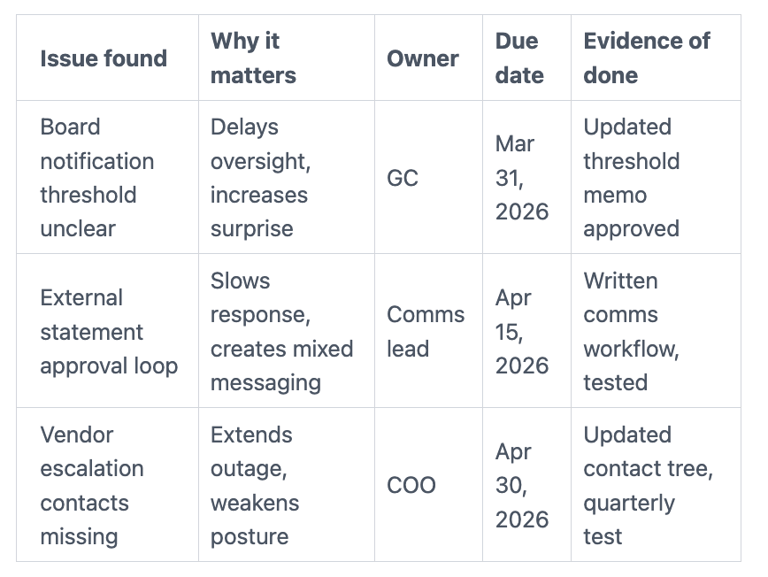
Keep the list short. Five to eight items is usually enough for the first cycle. Then re-run the scenario and show trajectory.
If you want a clean format for reporting back, use a board-ready exercise readout example so the output looks like governance proof, not meeting notes.
Scenarios that work well for boards in 2026, plus FAQs you will get asked
In 2026, the most useful scenarios are the ones that combine technical disruption with governance tension. You’re not just practicing an incident. You’re practicing credibility.
Here are scenarios that consistently surface board-level decisions:
Ransomware with extortion pressure: Do you shut down systems, pay, notify, or hold? Who owns the call, and what proof do you require?
AI model or data incident (leak, misuse, hallucination with customer harm): Do you pause the feature, disclose, or change claims? What does “responsible use” mean under pressure?
Physical security breach (facility incursion with operational disruption): Do you initiate lockdown, evacuate, or reroute critical functions while maintaining oversight?
Critical vendor outage with customer impact: How do you manage accountability when it’s not your system, but it is your brand?
Regulatory inquiry after a near-miss: What do you disclose, how fast, and who speaks for the company?
M&A surprise (breach discovered in diligence, or rumor-driven market reaction): Do you pause, re-price, disclose, or walk?
Reputation shock (executive misconduct allegation tied to culture and controls): When do you act, what do you say, and what do you document?
If vendor dependency is a known weak spot, don’t just talk about it. Map handoffs and escalation paths so the next outage doesn’t turn into internal chaos. A simple tool like the cross-functional handoff map worksheet helps you see where time and accountability disappear. Follow up with a hot wash to gather immediate feedback, then document action items in an after-action report that includes a business resiliency action log.
For a broader plain-language explanation of how tabletop exercises work across crisis types, Global Guardian’s guide on what tabletop exercises are and how they work is a useful reference to share with leaders who haven’t done one before.
FAQs your directors will ask
How often should you run a board tabletop exercise?
Quarterly is great for fast-changing risk. Semi-annual is a strong baseline. The key is repeating the loop: rehearse, fix, recover, re-run.
How long should it be?
Two to three hours is the sweet spot for board-level decisions. Shorter sessions tend to stay theoretical.
Should you include the full board or a committee?
Start with the committee that owns the risk (often audit or risk), then expand once the format works and the decision rights are clear.
Do you need perfect plans before you run it?
No. The exercise will show you which parts of the incident response plan matter and which parts are fantasy.
What should the board ask during the exercise?
Ask about thresholds, time-boxes, external messaging, and escalation cadence. Avoid asking for tool details unless they change a decision.
How do you keep it from becoming a blame session?
Set rules up front, then enforce them. You are testing the system, not judging people.
How do you improve cross-functional coordination?
Treat handoffs as first-class work. If Legal, Comms, Ops, and Security don’t share a clock, you will stall.
Conclusion
Talking through a crisis is not the same as deciding under pressure. A board tabletop exercise gives you a safe place to practice the hard part: making clean calls with incomplete facts for effective governance, then communicating with discipline. When you rehearse together, you cut decision latency. You reduce side channels. You stop improvising in public. That’s how you protect trust and build resilience.
If you want your next session to produce real proof, not just good conversation, take one small step: pick a scenario, define one outcome, and design the exercise around observable decisions in your incident response plan. Then turn the debrief into owners and deadlines.
When you’re ready, schedule a short call to choose the right scenario and format, using booking a readiness call as the simplest next step. Your future self will thank you when the room gets tense, and your board members stay calm.