
Cross functional handoff map worksheet
Make alignment tangible. Find the handoffs that fail before the real incident does.
A one page worksheet plus a one page example that forces seam failures into the light.
No spam. Unsubscribe anytime. We will email the worksheet plus a short set of follow-ups on decision readiness.
Security to legal. Legal to comms. Comms to exec. Exec to ops. The seams are where time disappears.
Make failure modes specific. Time lost, missing info, conflicting messages.
Define done in a way you can prove. If you cannot prove it, it is not done.
Why this exists
Most response plans assume people will line up automatically. They do not. The first real friction shows up at the seams between functions.
This worksheet makes those seams visible. It helps you name the handoffs, document how they break, and define what done means so teams can move without arguing.


What you get
A Handoff Map Grid That Forces Clarity
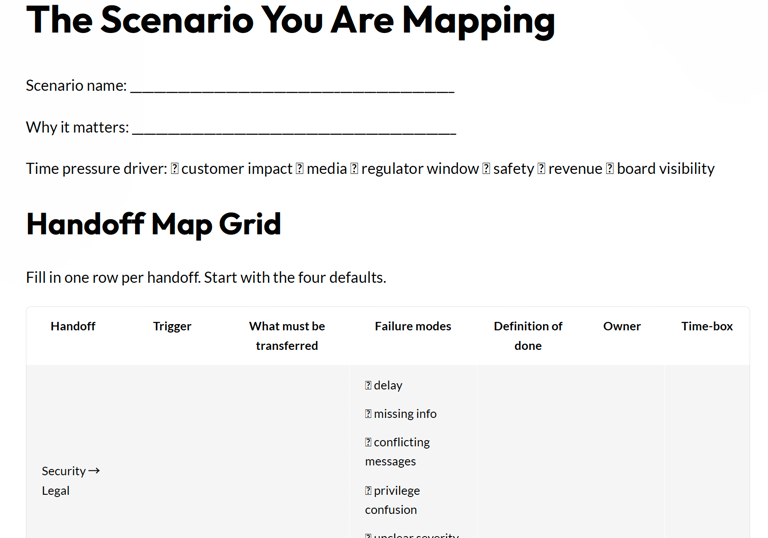
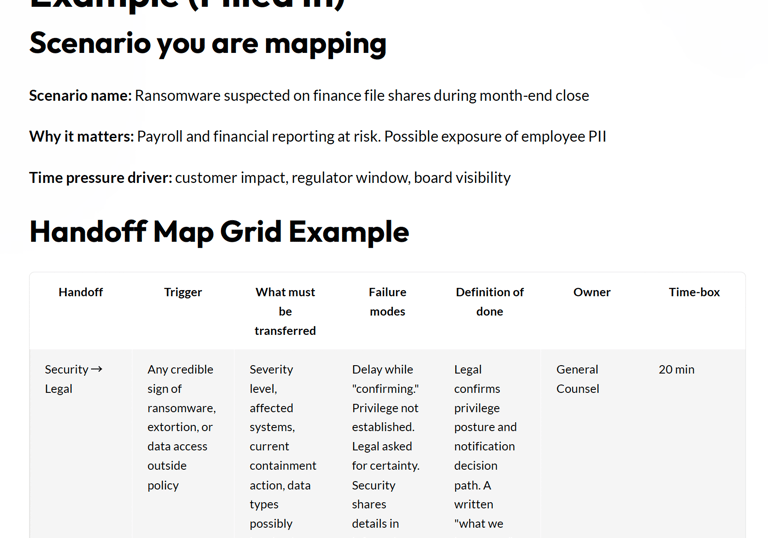
Handoff. Trigger. What must be transferred. Failure modes. Definition of done. Owner. Time box.
A Scenario The Creates Urgency
Name the scenario, why it matters, and the time pressure driver. Customer impact, media, regulator window, safety, revenue, board visibility.
The Four Default Seams Most Teams Trip On
Security to legal. Legal to comms. Comms to exec. Exec to ops.
Failure Mode Prompts That Make It Real
What info was missing. Where signals conflicted. Where time was lost and why. What assumptions were wrong.
Simple Quality Rules For Clean Handoffs
One owner per handoff. Consults are voices, not votes. Time box expiration triggers escalation. External messaging stays consistent with current comms posture.
Worksheet preview
Here is the structure you will fill out. It is designed to be fast and uncomfortable in the right way.
The Trigger and Transfer Fields
You stop vague updates. You define exactly what must move across the seam.
The Failure Modes Checklist
Delay. Missing info. Conflicting messages. Privilege confusion. Unclear severity.
Done means you can point to an artifact, a decision, or a published statement. Not a feeling.
Definition of Done That is Observable
Who is this for
Best for
Security leaders, IR leads, IT ops
General Counsel, privacy, compliance
Comms leaders
COO or exec sponsor, business owners
Best when
You have near misses that keep repeating
Legal and comms stall each other under stress
Executives get surprised and start side channels
Ops executes without constraints and IT makes business calls


How to use it in 15 minutes
Pick one recent near miss or a realistic scenario.
Fill in the four core handoffs first. Add more only if needed.
Keep failure modes specific. Then write a definition of done you can prove.
Assign one owner for the handoff. Not a committee. Add a time box.


Quick FAQs
Is this only for cyber incidents?
No. Use it for any high stakes situation where cross functional decisions and external messaging matter.
What does good look like?
One owner per seam. A clear transfer artifact. A time box. Escalation if time expires. No conflicting messages.
What makes this different from a plan?
Plans describe what should happen. This maps what actually breaks at the seams, then forces a provable definition of done.
What should we do after we fill it out?
Pick one change shipped. Make it real, assign an owner, set a due date, and require it at the next handoff.
Want fewer seam failures and faster decisions under pressure
Use this worksheet to make handoffs inspectable. Then fix the one seam that wastes the most time.

