
Speaking the Unspoken: Building Psychological Safety for Honest Risk Reporting
Building Psychological Safety for Honest Risk Reporting helps you get bad news early, set clear escalation rules, and stop surprise board-level crises.


You already know the painful pattern. Something goes wrong, the board wants answers, customers want clarity, regulators want timelines, and your exec team wants to understand why nobody raised the flag earlier.
And in the quiet part of your mind, you’re thinking: I’m accountable either way. If you punish messengers, risk goes underground. If you let anything slide, standards erode. You’re stuck between speed and safety, candor and control.
That’s why psychological safety matters in high-stakes leadership teams. In plain language, it means people can speak up with bad news, doubts, and weak signals without fear of embarrassment or retaliation. Not because you want comfort, but because you want truth fast enough to act.
“Speaking the unspoken” is the moment someone says, “This vendor is failing,” or “This metric is being gamed,” or “We’re one outage away from a notification threshold,” before it’s a headline. You can’t demand that moment. You have to design for it.
Key takeaways you can use right away to get honest risk reporting
Psychological safety is not “be nice,” it’s “tell the truth early so we can act.”
Silence has a cost, it shows up as surprise escalations, slower decisions, and board confidence cracks.
Your fastest win is how you respond in the first 10 seconds after bad news, calm curiosity beats blame.
You raise speak-up rates when you ask for dissent out loud, reward early signals, and close the loop with reporters.
You make reporting safer when decision rights are clear, escalation paths are written, and thresholds trigger action automatically.
Building Psychological Safety for Honest Risk Reporting works best when you pair leader behavior with simple systems and repeated practice.
Start this week by adding one standing question to every exec review: “What feels off, even if you can’t prove it yet?”
Why smart teams still stay quiet about risk (and how it shows up too late)
Smart teams go quiet for basic human reasons. They don’t want to look incompetent. They don’t want to be seen as a blocker. They’ve watched what happens to the last person who raised a concern at the wrong time, in the wrong forum, or with the wrong tone.
Power distance does the rest. When a CEO, board chair, or senior committee is in the room, people edit. They shorten sentences. They soften language. They skip the “I’m not sure.” They trade accuracy for composure.
You also get silence when the rules aren’t clear. If people don’t know who owns a call, they avoid raising a risk that might be seen as “going around” someone. If decision rights are fuzzy, honesty becomes political.
The outcomes are predictable, and they are the outcomes leaders actually care about:
Decisions slow down because the room is working with incomplete facts.
Escalations arrive late, loud, and expensive.
Compliance exposure rises because timelines and evidence get shaky.
Customers get harmed because weak signals weren’t acted on early.
Board trust erodes because the story keeps changing.
This is the core issue: low psychological safety doesn’t create less risk. It creates less information at the exact moment you need clarity.
For a broader view of how governance and risk expectations are tightening, see Diligent’s GRC strategy guidance.
The hidden cost of “everything is fine” reporting
In low-safety cultures, status reporting turns into theater. It looks clean. It sounds confident. It’s also brittle.
Watch for signals like these:
Updates that feel overly polished, with no tradeoffs or open questions.
Escalations that appear at the last minute, framed as sudden surprises.
Metrics that only move one direction, as if reality is always improving.
Vague language, “should be okay,” “low risk,” “we’re monitoring,” with no thresholds.
Real escalation happening in side chats, not in official channels.
The most damaging part is that you lose the early warning window, the period where a small correction prevents a big outcome.
Here’s the contrast you’re trying to create:
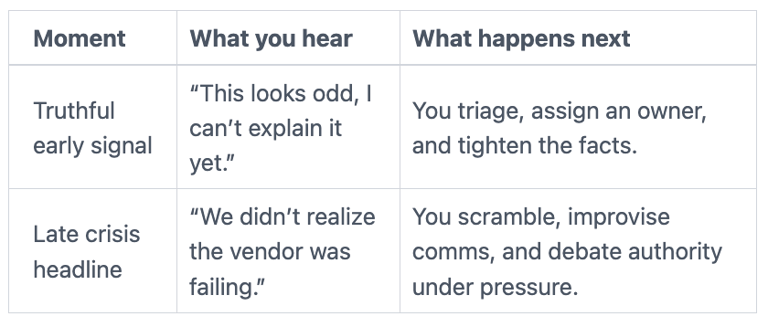
If you want a useful lens on why people misread signals under pressure, Risk Management Magazine’s piece on cognitive biases in risk management is a solid refresher.
How pressure and hierarchy change what people say in the room
Pressure doesn’t just speed things up. It narrows what people are willing to say.
Time pressure makes uncertainty feel inconvenient. Hierarchy makes disagreement feel dangerous. Cross-functional tension makes candor feel like a fight you don’t have time to win.
Picture a familiar moment: Security sees an exposure path. Legal sees privilege and notification risk. Product sees roadmap impact and customer churn. Everyone is interpreting the same risk through a different clock. So people self-censor to avoid conflict, especially in front of senior leaders.
You don’t need the room to be softer. You need it to be safer for uncertainty. Your job is to make it normal to surface doubt early, not only to reward certainty.
Make it safe to raise risks, your leadership moves matter more than your policy
You can publish all the policies you want. People will still watch what happens to the first person who brings bad news in a high-profile meeting.
Psychological safety is built in small, observable moments. What you say. What you do next. What you reward. What you ignore.
This is true whether you’re a CEO, a board chair, a functional leader, or the person who runs the operating rhythm. In high-stakes teams, your role is less “motivator” and more “air traffic control.” You’re creating clear lanes so information can land without drama.
And it has to be consistent. One calm response doesn’t fix a year of messenger punishment. But consistency does compound. When people see that risk reporting leads to thoughtful action, not humiliation, the flow of truth improves.
If you want evidence-based grounding on what psychological safety is (and what leaders do to create it), McKinsey’s report on psychological safety and leadership development is worth keeping in your back pocket.
Say the words that invite risk, then prove you mean it
Most leaders think they’ve invited candor. But “bring me problems” is not a script. It’s a slogan. Under pressure, people need specifics.
Try simple lines like:
“I want one reason this plan could fail.”
“Who disagrees, and why?”
“What are we missing that would embarrass us later?”
“If this goes wrong, where does it go wrong first?”
“Thank you for raising that early, that’s what we need.”
When someone does bring bad news, your response sets the tone for the whole system. A clean pattern is: pause, clarify, separate the person from the problem, decide next steps, and state what will happen next.
You can even say it out loud: “I’m glad you raised it. Let’s get clear on facts, then we’ll decide.”
Don’t do these things, even once, if you want honest risk reporting:
Defensiveness: arguing your way out of the signal.
Sarcasm: joking at the reporter’s expense.
Instant blame: asking “who caused it” before “what’s true.”
Premature certainty: forcing a conclusion to end discomfort.
Psychological safety isn’t built by being gentle. It’s built by being fair, curious, and steady.
Build fairness with consistent standards and clean follow-through
People speak up more when they can predict what happens next. Not because they want bureaucracy, but because predictability reduces social risk.
That means documented expectations (what you expect to be surfaced, how fast, through which channel). It means neutral fact-finding instead of emotional interrogation. It means closing the loop with the person who raised the issue, so they know it mattered.
A simple “report to action” pathway keeps you honest:
Receive, triage, decide, communicate, track.
If you skip the last two, people stop reporting. If reporting disappears into a void, you’ve trained the team to conserve effort and stay quiet.
Also watch the hidden punisher: ambiguity about who decides what. When authority is unclear, a well-meaning escalation can look like insubordination. That’s how honesty gets punished indirectly.
Turn honest risk reporting into a system, not a personality test
If risk reporting relies on personal bravery, you’ll get it only from a few people, and only some of the time. You want the opposite. You want it to feel routine, expected, and normal.
Think of your system like a smoke alarm. You don’t want someone to debate whether they’re “allowed” to pull it. You want clear triggers and a known response pattern.
The goal isn’t to create a culture of fear. It’s to create a culture where early signals are treated as useful data, and where board visibility improves without turning updates into blame sessions.
Clarify decision rights so raising a risk does not feel like breaking ranks
When someone says, “I didn’t know who I was allowed to tell,” your decision system is already leaking.
You don’t need a perfect RACI. You need plain language:
Who owns the call. Who must be consulted. Who must be informed. What triggers escalation. What’s time-boxed.
A lightweight way to start is a one-page map for your top scenario, then iterate after you test it. You can use a ready-made template like the decision rights map template to make “who decides what” explicit without turning every decision into a committee.
Once decision rights are clear, risk reporting becomes less personal. People aren’t “challenging a leader.” They’re activating the agreed system.
Use thresholds and “stop rules” so risk talks are about facts, not personal courage
Stop rules are pre-agreed triggers that force action, a pause, a rollback, a notification, or a board update.
They sound simple. They also remove a lot of social friction. When the threshold triggers, it’s not “your opinion” versus “my opinion.” It’s the system doing what you agreed it should do.
Examples you can adapt quickly:
Cyber: confirmed lateral movement, encryption activity, or loss of privileged credentials triggers an exec briefing within 30 minutes.
AI: model output indicates a prohibited use case, or a high-severity incident report appears, triggers a product pause and legal review.
Vendor failure: outage exceeds a defined duration, or the vendor misses a comms checkpoint, triggers your contingency plan and customer messaging posture.
Operational outage: customer impact crosses a defined threshold, triggers a public status update cadence and a board notification rule.
Pair stop rules with a clear kickoff structure so the first decisions don’t get lost in debate. A practical companion is The First 30 Minutes runbook, which helps you align owners, time-box decisions, and set comms posture while facts are still incomplete.
Practice the hard conversations before the stakes are real
In real incidents, you don’t rise to your intentions. You fall to your practiced habits.
If you want people to speak honestly under stress, they need reps. They need to try the words, feel the tension, and learn that candor doesn’t end careers.
Practice is also where you find the quiet problems: the weak signals nobody owns, the handoffs that always break, the approvals that create hidden delays, the board update that turns into a debate.
Why simulations help people speak up, even when the room gets tense
A good simulation creates a shared experience under controlled pressure. The clock is running, but the consequences are learning, not damage.
That changes behavior. People take the scenario seriously, but they’re more willing to say, “I’m not sure,” or “This feels risky,” because the debrief is structured around decisions and signals, not blame.
Over time, rehearsals build muscle memory. Reporting becomes faster. Escalation becomes cleaner. And the team stops treating uncertainty like a personal failure.
If you want a clear picture of how this method works, start with simulation-based readiness.
How to bring in SageSims without making it feel like “training”
If your team hears “training,” they’ll expect slides, hypotheticals, and polite discussion. That’s not what you need.
A simple rollout that respects executive time looks like this: pick one high-impact scenario where decision delay would create real harm, include the real roles (ops, risk, legal, comms, finance, plus board observers if appropriate), run a short simulation, then convert lessons into a 30 to 60 day backlog with owners and dates.
That’s the point of business decision simulations: you practice decision-making where it actually breaks, under time pressure, across functions, with real tradeoffs.
You’re still the hero of the story. You’re the leader building a truth-telling system. SageSims is the guide that gives you a safe, structured place to pressure-test it.
FAQs leaders ask about psychological safety and risk reporting
How do you balance psychological safety with accountability?
You make it safe to report risk and mistakes, and you stay rigorous about follow-through. Psychological safety isn’t protection from standards, it’s protection from humiliation. You can be kind to the person and demanding about the work.
Does anonymous reporting help, or does it make things worse?
Anonymous channels can surface issues that would otherwise stay buried, especially when power dynamics are strong. But they’re not a substitute for day-to-day safety in meetings. Use anonymity as a pressure relief valve, then fix the system that made it necessary.
What if a senior leader is the reason people don’t speak up?
Treat it like any other risk. Name the pattern, use specific examples, and set a clear expectation for behavior in high-stakes rooms. If you can’t address it directly, you’ll keep paying for it in late surprises.
How can the board test readiness beyond slide decks?
Ask management to show how decisions get made under pressure, not just what policies exist. A rehearsal with a structured, board-friendly output is one of the clearest signals of maturity. A simple artifact like a sample board-ready readout helps you standardize what “good” looks like.
How do you measure improvement in honest risk reporting?
Watch leading indicators: earlier escalations, more dissent raised in the room, clearer thresholds, fewer side-channel escalations, and faster time-to-decision with fewer reversals. You can also pulse survey psychological safety, then compare it to near-miss reporting volume and cycle times.
How do you handle false alarms without punishing the reporter?
You thank them for raising the signal, then you tighten the trigger definition. Treat it like tuning a smoke alarm, not like catching someone “being wrong.” If people get punished for false alarms, they’ll stop reporting, and the next one won’t be false.
Conclusion
You get earlier, clearer risk signals when you pair leader behavior with simple systems and real practice. That’s the promise. Not comfort, not theater, just truth fast enough to reduce harm.
Your next step can be small and still matter: pick one scenario you can’t afford to improvise, define decision rights and stop rules, then rehearse it with the leaders who will be in the room when it’s real. If you want help choosing the right first rehearsal and making it board-useful, book a readiness call. When you lead the change, your team learns to speak the unspoken before it becomes damage.