
Speed as a Strategy: Calculating the Real Cost of Decision Bottlenecks in Your Organization
Calculating the Real Cost of Decision Bottlenecks in Your Organization, use simple math to expose delay costs and set decision SLAs this week.


.A strategic initiative is ready to ship. The team’s done the work. Customer support is on standby. Then it happens: “We’re waiting on approval.”
Days pass. Slack threads multiply. Project timelines tighten. The launch window closes. Risk grows in the background, quietly.
A decision bottleneck is simple: work pauses because the right decision maker, the right data, or the right meeting isn’t available. Nothing is “blocked” in the plan. But reality says otherwise.
This isn’t just annoying. It’s expensive. West Monroe’s January 2026 research describes a “Slowness Tax,” estimating delayed decisions can cause revenue erosion of up to 5% of annual revenue (a board-level number, not an ops footnote). See the West Monroe “Slowness Tax” research release for context. The point of this post is to make that cost visible, using math you can do in a spreadsheet, so speed becomes a strategy, not a personality trait.
Key takeaways: how to spot, measure, and fix decision bottlenecks fast
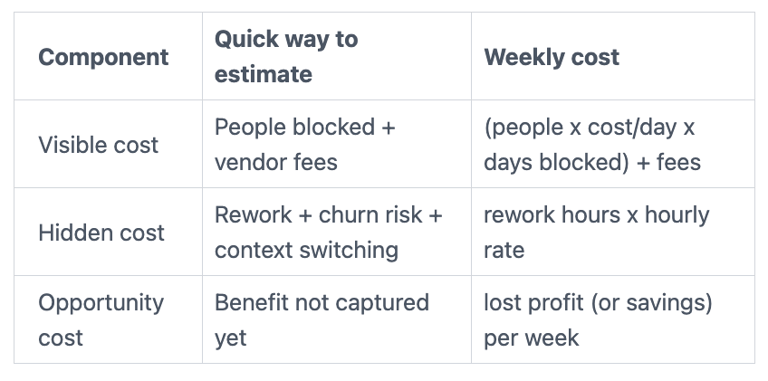
Three cost buckets matter: visible costs (labor, fees), hidden costs (rework, churn, employee morale), and opportunity costs (missed revenue, delayed risk reduction).
Use a simple rule: weekly cost of delay = (people cost + external cost + rework cost + lost benefit).
Root cause analysis reveals the usual root causes of approval bottlenecks are boring: too many approvals, unclear decision rights, and fear of risk that turns every call into a committee.
Start collecting data this week: how many decisions are waiting, how long they wait, who must say yes, and how many people are stuck while waiting.
Track one metric that leaders respect: days-to-decision for your top 10 recurring decision types.
Quick win: set a decision SLA (time limit) and name a single owner who is accountable for closure, not consensus.
What decision bottlenecks really look like inside teams (and why they keep repeating)
Decision bottlenecks don’t show up as villains. They show up as “good process.” A steering committee that meets every other week. A risk review that requires perfect data. A legal sign-off that starts after work is finished, not before. A vendor approval chain where no one knows who can say yes. Bottleneck analysis reveals these hidden delays inside what seems like good process.
They repeat because modern work is cross-functional, requiring constant stakeholder engagement. Product can’t move without security. Security can’t move without legal. Legal won’t move without clear business intent. And executives can’t decide because the question isn’t framed as a decision, it’s framed as an update.
Here are the symptoms leaders see, often in plain sight. Process mapping can help visualize them:
Meetings that end with “socializing” instead of a decision and an owner
Decisions made twice, once informally, then again in the “right” forum
Work packaged for approval, then re-packaged when the approver asks a new question
Escalations that feel personal, because decision rights weren’t clear upfront
Teams optimizing for not getting blamed, leading to productivity loss, not for outcomes
Silence after “we’ll take it offline”, because there’s no deadline to close
The hardest part is that bottlenecks hide inside normal governance structure. That’s why they survive reorganizations. You can change the org chart and still keep the same slow decision system.
Calculating the Real Cost of Decision Bottlenecks in Your Organization with simple math
Benchmarks are useful, but your board will ask the obvious question: “What’s it costing us?” This is where Calculating the Real Cost of Decision Bottlenecks in Your Organization, particularly for delayed decisions, becomes practical instead of theoretical.
Build a sheet with one row per stalled decision. For each one, capture five inputs. Keep it rough at first. Rough beats invisible.
Waiting time
How many business days has the decision been open?People stuck (or slowed)
How many people can’t finish their work until the decision lands, quantifying resource idle time?Loaded cost per day
Use a simple estimate: annual salary plus benefits, divided by 260 workdays. If you don’t have loaded rates, use salary as a proxy and call it conservative.External and rework costs
Contractor standby fees, inventory costs, change orders, expedite shipping, rework hours, duplicate analysis.Opportunity cost (lost benefit per week)
This is the big one. Delayed revenue, delayed savings, delayed risk reduction. Use contribution margin for revenue items, not top-line.
A simple formula you can copy:
Mini worked example (round numbers)
A mid-size launch needs one approval (pricing exception, legal language, or risk sign-off). It waits 10 business days.
Resource utilization drops for 8 people, who lose 1.5 hours/day each
Average loaded cost is $700/day per person (rough, but usable)
Rework adds 20 hours across the team at $100/hour
The launch is expected to add $60,000/week in gross profit once live
Now the math:
People cost: 8 people x (1.5/8 of a day) x $700/day x 10 days = $10,500
Rework: 20 x $100 = $2,000
Opportunity cost: $60,000/week x (2 weeks) = $120,000
Total budget impact for one “simple” delay: $132,500.
Run that pattern across a portfolio and the West Monroe “up to 5% of revenue” benchmark stops sounding dramatic. It starts sounding familiar.
If you want a structured way to pressure-test decision speed under realistic time pressure, this is where decision readiness simulations can help leaders see the bottlenecks as they happen, not months later in a postmortem.
Turn speed into a repeatable system (not heroics)
Most organizations don’t need more urgency. They need fewer open loops.
Drawing from the Theory of Constraints, speed gets reliable when you treat decisions like operational work, with clear ownership and time limits. The core objective is decision velocity. The goal isn’t recklessness. It’s boosting throughput by reducing the dead time where nothing moves and risk quietly expands.
Start with operating rules that make waiting expensive, incorporating workflow automation:
One decision owner: one named person accountable for closure, even when they need input.
Decision rights: who decides, who must be consulted, who is informed. Write it down for the top recurring decisions.
Time boxes (decision SLAs): “We decide in 72 hours with current facts.” If you miss the SLA, you escalate automatically.
Stop rules: define what would pause a rollout, trigger customer notice, or require board notification. This reduces fear-driven stalling.
Escalation path: if the owner can’t decide, the next forum is pre-set, and it meets often enough to matter.
Then add a feedback loop so it sticks. Pick ten decision types that drive the most delay (vendor renewals, risk exceptions, comms approvals, pricing exceptions, incident thresholds). Track cycle time monthly, along with lead times. Review the worst two and fix the system, not the people.
Many leadership teams find it easier to change behavior after they’ve rehearsed it. A short, focused simulation can create shared language fast, then you turn it into policy. If you want that kind of reset, you can book a readiness call and map a first session around your most painful bottleneck.
FAQs leaders ask when fixing decision bottlenecks
“If we go faster, won’t we take more risk?”
Not if you make risk explicit. Speed improves when you define thresholds, stop rules, and who owns the call. Slowness often hides risk and breeds decision fatigue because people assume “someone else is reviewing it.”
“How do we avoid breaking governance?”
Governance breaks when decisions drift into side channels. Clear decision rights and escalation paths protect governance. The board gets better oversight when management can show days-to-decision trends and repeatable controls.
“What if we don’t have good data to decide?”
You rarely will. Set a time box, decide with what you have for data-driven decision-making, and define what would change the decision later. That’s more honest than waiting for perfect information that won’t arrive.
“Who should own decision speed?”
Make it a shared metric, but give one executive the job of driving the system for operational efficiency and continuous improvement, often the COO, CFO, or chief of staff. Without an owner, the bottleneck becomes “everyone’s problem,” which means no one fixes it.
Conclusion
Decision bottlenecks aren’t just friction, they’re a real dollar drain you can measure via bottleneck analysis with a few inputs you already have. When you quantify the visible, hidden, and opportunity costs, decision velocity stops being a vibe and becomes a governance discipline.
Pick one stalled decision area this month. Baseline the wait time, blocked capacity, and lost benefit. Then run one focused continuous improvement cycle with a decision SLA and a single owner. You’ll feel the difference fast.
And if you want support designing the rehearsal that exposes the real bottlenecks, use the readiness call link shared earlier.