
How to Stay Calm and Effective in Difficult Board Conversations
Use How to Master Difficult Board Conversations with Strategic Calm so you prep, slow the room, set decision rights, and send a 24-hour recap.


You walk into the boardroom knowing today won’t be a normal update. The quarter missed. A vendor outage is still rippling. An activist is circling. A CEO transition timeline is suddenly real. Someone wants to talk about AI risk, and nobody agrees on what “good oversight” even means.
In that kind of meeting, calm isn’t a personality trait. It’s a governance tool. When you stay steady, you protect clarity, keep trust from fraying, and shorten the distance between debate and decision. When you don’t, the room gets loud, facts get soft, and everyone leaves with a different memory of what just happened.
This is a practical playbook for How to Master Difficult Board Conversations with Strategic Calm without going passive. You’ll prepare in a way that lowers heat, run the conversation with disciplined pace, and close the loop so tension doesn’t roll forward into the next meeting.
Key takeaways you can use in your next board meeting
Send pre-reads early, and name the 3 hardest questions upfront.
Start with the biggest decision while attention is high.
Say the decision out loud, don’t hint at it.
Set decision rights before debate (who recommends, who decides).
Use short pauses to slow the room, and stop cross-talk.
If facts are missing, separate “known” from “unknown,” then set a time to confirm.
Document next steps with owners and dates, and send them within 24 hours.
Prepare so you do not get pulled into the heat of the moment
Calm is built before the meeting, not during it. If you wait until a director is already frustrated, you’re trying to install guardrails while the car is sliding.
Your goal in prep is simple: reduce surprise, reduce ambiguity, reduce ego-threat. Surprises create emotion. Ambiguity creates conflict. Ego-threat creates defensiveness. All three slow decisions.
Start by planning for the first five minutes. That opening sets the emotional temperature. If the first thing directors hear is a long preamble, someone will interrupt to “get to it.” If the first thing they hear is a crisp framing, you earn room to think.
Treat your prep like an aviation checklist. Not because boards are mechanical, but because high-stakes conditions shrink attention. Checklists protect you from skipping steps when your heart rate rises.
Also decide what you will not do. You will not trade facts for reassurance. You will not improvise ownership in the moment. You will not let side debates turn into shadow decisions. Those are the hidden sources of boardroom chaos.
If you want a benchmark for how leaders handle a tense director relationship without turning it into a personal contest, see HBR’s guidance on difficult board members. You’re not trying to “win” the room. You’re trying to keep the work on track.
Build an agenda that reduces surprises and forces clarity
A board agenda can either absorb pressure or amplify it. The difference is whether you design it for decisions or for presentations.
Send pre-reads 1 to 2 weeks early when you can. If timing is tight, at least send a short “what changed since last time” note 48 hours ahead. Directors hate being surprised in public. They’ll react, not reason.
Then list the 3 hardest questions right on the first page. Not buried. Not implied. You’re telling the board, “We’re not hiding the hard parts.” That lowers suspicion fast.
Time-box topics, and put the hardest items first. Energy drops as the meeting goes on. So does patience. A late agenda item often becomes a rushed fight because the clock forces people to simplify.
Use a consent agenda for routine items. Approvals, minutes, standard reports. Don’t burn the best cognitive minutes on housekeeping.
Here’s a simple checklist you can paste into your next board pack:
Decision needed today (one sentence)
Why now (what forces timing)
Options (2 to 4, with tradeoffs)
Risks and thresholds (what you won’t accept)
What changed since last meeting
Top 3 board questions (answered plainly)
Ask of the board (vote, guidance, or acknowledgement)
The checklist isn’t about control. It’s about reducing the chance that the meeting turns into a scavenger hunt for what matters.
Decide your “red lines” and decision rights before the room debates
Unclear authority is gasoline. People may be polite, but they’re still asking, “Who’s really in charge here?” When that’s fuzzy, every disagreement becomes a power test.
Before you enter the room, define decision rights in plain language:
Who recommends (does the work and proposes)?
Who decides (has the call today)?
Who must be consulted (can block, advise, or warn)?
What must be escalated (cannot be decided in the room without more input)?
This matters most in crisis-adjacent topics: cyber response, public disclosures, CEO succession steps, activist engagement, AI model failures, safety incidents. The facts are incomplete and the consequences are asymmetric. That’s when people reach for control.
Also define your “red lines,” the boundaries you won’t cross even under pressure. Examples: not committing to a public statement without legal review, not changing risk posture without documenting the threshold, not approving a major pivot without a stop rule.
If you want a solid reference point on board communication basics that reduce tension, PwC’s overview of five essentials for boardroom communication aligns with what works in real meetings: clarity of purpose, crisp materials, and disciplined follow-through.
Stay steady in the room: calm tactics that keep the conversation productive
In the room, your job is to control pace, not emotion. Emotion will show up. Let it. But pace is the lever that keeps emotion from taking the wheel.
Start with posture and cadence. Sit still. Feet on the floor. Shoulders down. Speak a touch slower than feels natural. When you speed up, the room reads it as fear or spin, even if you’re just trying to be efficient.
Then control the “shape” of the conversation. Most board tension comes from three patterns:
People argue about facts they don’t share.
People argue about values they haven’t named (risk tolerance, customer harm, reputation).
People argue about authority they haven’t clarified.
So you keep returning to a few anchors: the decision, the options, the thresholds, the owner, the next checkpoint.
A board-ready update also lowers anxiety. If your materials read like a marketing deck, directors will ask sharp questions to find the truth. If your update is structured, they can focus on judgment. Russell Reynolds has practical perspective on managing disagreement in the boardroom, and the theme is consistent: good conflict needs structure so it doesn’t turn personal.
Use a simple script to slow things down without shutting people down
You don’t need perfect words. You need repeatable phrases that buy time and protect trust. Here are “say this, not that” lines you can use when pressure rises:
“Let me pause and confirm the decision we need today,” not “We’re getting off track.”
“Here’s what we know, and here’s what we don’t know yet,” not “It’s too early to say.”
“What would change your mind,” not “You’re being unrealistic.”
“What risk threshold are we not willing to cross,” not “We can’t take that risk.”
“I’m hearing two different goals. Let’s name them,” not “You’re talking past each other.”
“Do you want a decision today, or do you want more analysis,” not “We need more time.”
“I can commit to an answer by Friday at 3 p.m.,” not “We’ll follow up.”
When emotions rise, breathe out longer than you breathe in. It’s a small trick with a big effect on your voice. Also, speak last when you can. Let directors air concerns first, then summarize what you heard. A good summary lowers volume because people feel seen.
If you want a broad set of conflict patterns boards fall into (and how to interrupt them), NACD’s overview of strategies to manage boardroom disagreement is a useful reference point.
When a director comes in hot, separate the concern from the tone
A director may be sharp, impatient, or even rude. Don’t mirror it. Don’t reward it either. Separate the signal from the noise.
Use a four-step sequence that de-escalates without surrendering your role:
Acknowledge the concern: “You’re worried we’re under-reacting to customer impact.”
Clarify the claim: “Is the core issue speed, transparency, or controls?”
Reframe to shared goals: “We all want continuity, customer trust, and long-term value.”
Propose options and a decision: “Given that, here are two paths and the threshold that triggers each.”
If you get interrupted, don’t compete for airtime. Say, “I’ll stop there. Tell me what you want answered first.” That puts the other person back into responsibility, not performance.
If one voice dominates, ask the chair for a structured round: “It may help to hear one minute from each director on the decision, then we’ll respond.” Quiet members can be invited in without being put on the spot if the chair says, “If you have a different view, I’d like to hear it,” and then waits. Silence is often where the best risk signal lives.
Close the loop after the meeting so tension does not carry into the next one
Most boardroom tension isn’t caused by the meeting itself. It’s caused by what happens after, or what doesn’t.
If the board leaves without a shared record, people replay the debate in their heads. They also replay it with others. That’s how you get re-litigation next month. The same fight, just with better one-liners.
Your fix is follow-up discipline. Not busywork. Discipline.
Think of it as protecting the “decision asset.” A decision is only valuable if it stays intact long enough to execute. That means clean documentation, clear owners, and a rhythm for updates between meetings.
If your organization struggles to turn board commitments into cross-functional execution, it’s often a handoff problem. The work crosses functions and dies in the seams. Tools that map handoffs help, but the bigger point is the mindset: if nobody owns the handoff, nobody owns the outcome.
Board communication research repeats this theme: decisions stick when the follow-up is structured. Harvard’s corporate governance forum repost of PwC’s boardroom communication essentials underscores how much boards value clarity and cadence, not volume.
Send a clean decision recap within 24 hours
Send a recap while memory is fresh. Keep it short. Make it easy to forward.
A simple template can look like this:
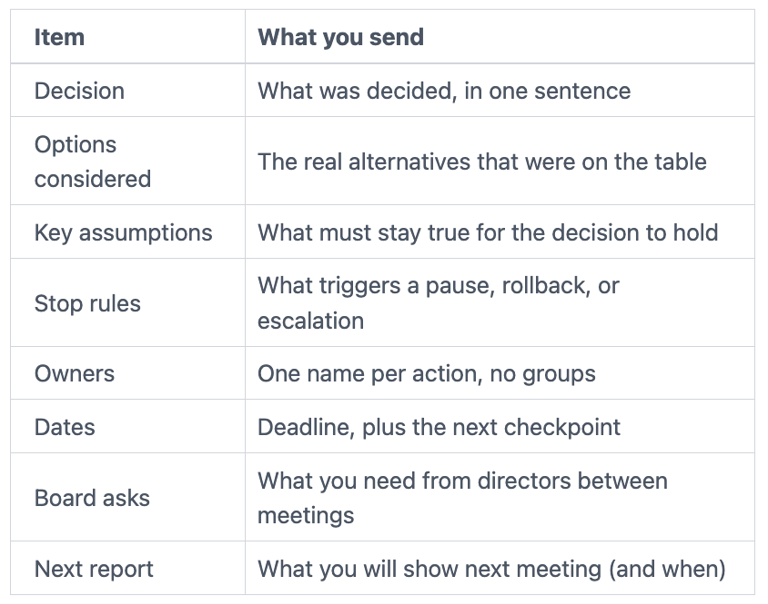
This reduces rehashing. It also protects trust. When directors see their input reflected accurately, they feel respected even if they didn’t get their preferred outcome.
Use quick 1:1s to prevent public replays of private friction
Some friction should never return to the full board. Handle it in short 1:1s.
Follow up with the chair or lead independent director when the meeting had heat, when there’s a CEO succession thread in play, or when committee boundaries were blurred. Talk with key committee leads when oversight topics are emotionally charged, like cyber incidents, crisis readiness, or AI governance.
Keep it practical. “Here’s what I heard you pushing for. Here’s what we can do this week. Here’s what we can’t do yet, and why.” Don’t litigate personality. Don’t trade in board politics. You’re protecting the decision process.
Practice the hard conversations before the stakes are real
You can’t “think” your way into calm when the room is on fire. You need reps. That’s why the best leaders treat readiness like a muscle, not a binder.
This is where simulation helps. Not as theater, and not as a check-the-box tabletop. The point is to practice the decision system: who speaks when, who decides what, what thresholds trigger escalation, how you communicate when facts are incomplete, and how the board pressures management without taking over.
If you’ve ever left a tense board meeting thinking, “We’ll do better next time,” you already know the problem. Next time arrives, pressure hits, and you fall into the same grooves. Practice changes the grooves.
SageSims fits naturally here because it gives you a safe place to rehearse hard board conversations with realistic pressure and timed decision points. You stay the hero. You bring the context, the stakes, and the leadership. SageSims plays the guide by giving you structured reps, clear scenarios, and a debrief that turns stress into specific improvements. If you want to explore that approach, you can start by looking at simulation-based readiness and business decision simulations, then book a readiness call when you’re ready to test your team.
Run a board simulation that tests your decision system, not just your plans
Don’t simulate what you already feel good about. Simulate what could embarrass you in public.
Strong scenarios include vendor failure, cyber disruption, an AI model issue in production, a regulatory inquiry that forces fast governance, or a major strategy pivot when the market moves against you. The goal is role clarity and escalation speed, not perfect answers.
In the simulation, force a few things:
Clear comms ownership (internal and external)
Explicit stop rules (what triggers a pause or rollback)
Realistic tradeoffs (customer harm vs uptime, speed vs certainty)
A board oversight posture that pressures without micromanaging
A vendor failure scenario is a great starting point because it exposes hidden dependencies fast, including contracts, comms, operational workarounds, and who has authority to declare an incident.
FAQs about staying calm in difficult board conversations
What if you don’t have the facts yet? Say that plainly, then separate what’s known from what’s unknown. Offer a time-bound plan to confirm, and name the decision that can still be made today.
How do you handle personal criticism? Don’t accept the frame. Redirect to the work. “I hear the concern. Let’s focus on the decision and the evidence we’re using.”
What if the board starts to micromanage? Ask for the outcome they want, then propose the oversight mechanism. “If the goal is control, would weekly metrics and thresholds meet the need without the board running execution?”
How do you push back without sounding defensive? Use tradeoffs and thresholds, not emotion. “If we do A, we accept B risk. If that risk is unacceptable, we need to choose C.”
What if directors disagree with each other? Summarize both positions fairly, then ask the chair to call the question or define what would resolve the disagreement (more data, a threshold, or a time-boxed experiment).
What if you lose your cool? Name it quickly. “I’m getting frustrated. I’m going to pause so I can be precise.” Then reset with the decision, the options, and the next step.
Conclusion
You don’t earn calm by trying harder in the moment. You earn it by preparing with clarity, running the meeting with disciplined pace, documenting decisions before memory drifts, and closing loops before tension hardens.
That loop is your advantage: prepare, stay steady, recap, follow up, practice. Repeat. Over time, the board stops bracing for impact and starts moving faster with you, even when facts are incomplete.
If your next hard conversation is already on the calendar, pick one step from this playbook and do it today. Then ask yourself a final question: what would change if your team practiced these moments before they were real? If you want outside help building that muscle without turning it into theory, decision readiness support can give you structure, reps, and a clean improvement path.