
Leadership Tabletop Simulations That Expose Decision Gaps Fast
Leadership Tabletop Simulations expose decision rights, escalation drag, and messaging gaps in 90 to 120 minutes, so leaders fix issues before crisis.


At 7:42 a.m., your largest customer pings the CEO. Their users cannot log in. At 7:49, a reporter emails comms with a rumor about a breach. At 8:03, your cloud vendor posts a vague status update. Meanwhile, legal wants facts, security wants containment, and revenue wants the site back up.
Everyone in the room is competent. That is not the problem. The failure pattern is simpler: the decision system gets unclear under time pressure.
Leadership Tabletop Simulations fix that by design. They are guided, time-boxed scenarios where real leaders practice real calls with incomplete information. In one session, you can see where decisions stall, where authority gets fuzzy, and where messaging splits. This post shows what "decision gaps" look like in practice, how to run a simulation that surfaces them fast, and how to turn findings into fixes that stick.
Key takeaways: what leadership tabletop simulations reveal in a single session
Decision rights breakdowns: smart people hesitate because no one owns the call.
Escalation drag: teams wait too long to pull in the right executives.
Missing stop rules: risk stays theoretical because thresholds are not defined.
Cross-functional friction: security, legal, ops, and comms move on different clocks.
Broken handoffs: critical information changes shape as it moves between teams.
Messaging gaps: internal updates and external statements drift apart fast.
Tradeoff blindness: leaders cannot name what they are optimizing for (time, trust, cash, safety).
A better outcome: the goal is not blame, it is speed, clarity, and coordinated action through simulation-based readiness programs.
The decision gaps that show up first, and why they are so costly
In a good simulation, you hear the gaps before you can even label them.
"Who owns this call?" "Do we tell the board now?" "Are we shutting down, or trying to limp along?" "Can we say anything publicly, or are we still investigating?"
These questions are normal. What is not normal is how long they linger.
Leadership Tabletop Simulations expose gaps quickly because they compress reality. The clock is running. Facts change midstream. Every function has a valid concern. Also, there is always a tradeoff. Restore service faster, or preserve evidence. Admit uncertainty, or risk being wrong in public. Contain quietly, or notify early.
That friction is where cost shows up. Minutes turn into hours, then into days. Customers lose trust. Regulators start asking pointed questions. Your own leaders start building side channels.
For a board, this is the difference between "management has a plan" and "management can decide." That distinction matters, especially after a year where US organizations kept getting hit with ransomware disruptions, vendor failures, and third-party exposure events. Plans do not fail on paper. They fail in the first tense hour.
The fastest way to find a decision gap is to force a decision before everyone feels ready.
Decision rights get fuzzy, so choices stall or get made twice
Most teams confuse "who is accountable" with "who decides right now."
Accountability can be shared in a postmortem. A decision cannot. Under pressure, unclear decision rights create two failure modes: the call never gets made, or two leaders make competing calls and both think they were authorized.
Common patterns show up fast:
Too many approvers, so leaders wait for consensus.
The CEO becomes a bottleneck for routine calls.
Legal and comms wait on each other, and nothing ships.
Security isolates systems without business sign-off, then gets blamed for revenue impact.
A simple fix is to map "who decides" for the handful of calls that always cause debate. The decision rights map template is built for that moment, because it forces one owner, required consults, and a time-box.
If you want an outside view on executive tabletop design, Forrester's guidance on effective executive tabletop exercises reinforces the same point: the value comes from decisions, not discussion.
Triggers and stop rules are missing, so risk stays abstract
When teams lack thresholds, they argue opinions. One leader says, "This feels bad." Another says, "We can ride it out." Nobody can answer, "What would make us stop?"
Stop rules turn vague risk into a clear decision. In a simulation, you force leaders to pick thresholds while the situation evolves. That is the muscle you want.
Concrete examples of stop rules:
Pause a rollout if error rates exceed X for Y minutes, or if a critical customer is impacted.
Isolate systems if there is credible evidence of lateral movement, even if it hurts operations.
Notify a regulator or key customer when a reporting clock may be triggered, even with incomplete facts.
The point is not perfect numbers. The point is shared ground rules, so the organization does not improvise in public.
How to run a leadership tabletop simulation that exposes gaps in under two hours
Speed comes from focus. A two-hour session can surface decision gaps if you treat it like a rehearsal, not a compliance event. You are not trying to "cover everything." You are trying to expose what breaks first.
Start by choosing one scenario where decision latency would hurt. Then invite the real decision chain, not just delegates. Run timed injects. Capture decisions and rationale in plain language. Debrief into owners and dates.
SageSims designs business decision simulations around that exact constraint: leadership time is limited, so the scenario must force the calls that matter.
A tight format helps:
0 to 10 minutes: roles, rules, and what "good" means today
10 to 70 minutes: 4 to 5 injects, each ending with a decision
70 to 110 minutes: debrief into fixes and assignments
110 to 120 minutes: confirm what changes, by when, and how you will re-test
Design the scenario around one uncomfortable decision, not a long story
If the scenario reads like a novel, leaders will debate details. Instead, design around one "make or break" call.
Prompts executives recognize immediately:
A vendor outage during peak week, with customers blaming you
Ransomware plus extortion demand, with unclear scope
An AI model causes customer harm, and the press notices
A regulator asks for answers in 24 hours
A merger integration breaks a key control
An executive misconduct rumor goes public
Keep scope tight: one timeline, one set of stakeholders, one decision that forces tradeoffs.
For realism, use a scenario kit that already bakes in the messy vendor dynamics leaders actually face, like the vendor failure drill kit. If you need additional design ideas, PreparedEx offers a practical step-by-step guide for executive tabletop exercises.
Facilitate for decisions, then debrief into actions leaders will actually do
Facilitation is where most exercises fail. The fix is simple: time-box updates, then demand decisions.
Every 10 to 15 minutes, ask for:
the decision,
the owner,
the next check-in time,
what information is missing.
Also, test board oversight without turning directors into operators. You want to see when and how management escalates, not have the board run the response.
Two tools make this easier. The first 30 minutes runbook creates a shared opening cadence, so the room does not melt into status updates. Then the sample board-ready readout forces clarity on what happened, what was decided, and what changes next.
If the debrief ends with "we should," you did not finish. End with owners and dates.
Turn what you learn into decision readiness, not a one-time event
A single simulation is useful. A repeatable loop is where confidence gets built.
Practice, learn, fix, repeat. Quarterly beats annual because teams change, vendors change, and risks shift. In addition, quarterly cadence keeps fixes small enough to ship.
Measure outcomes leaders respect: time-to-decision, number of unnecessary escalations, and whether stop rules exist for the top scenarios. Track whether comms ownership stayed clear. Track whether handoffs improved.
What to fix first: a short backlog that improves speed and trust quickly
Keep the backlog short, because nobody has patience for a 40-item remediation list.
Prioritize these five fixes:
Clarify decision rights for the few calls that always stall.
Define escalation triggers and stop rules tied to business impact.
Lock comms roles and the approval path before the headline hits.
Map cross-functional handoffs, especially where facts get lost.
Set a board update rhythm, including what triggers board chair notification.
To tighten the handoff work without guessing, use the cross-functional handoff map worksheet. If you want context on why leadership exercises matter at the crisis level, Bryghtpath's overview of crisis exercises aligns with the same principle: coordination beats heroics.
Simple scorecard: how to know the simulation actually made you better
Use a plain scorecard, then re-run the same scenario after fixes.
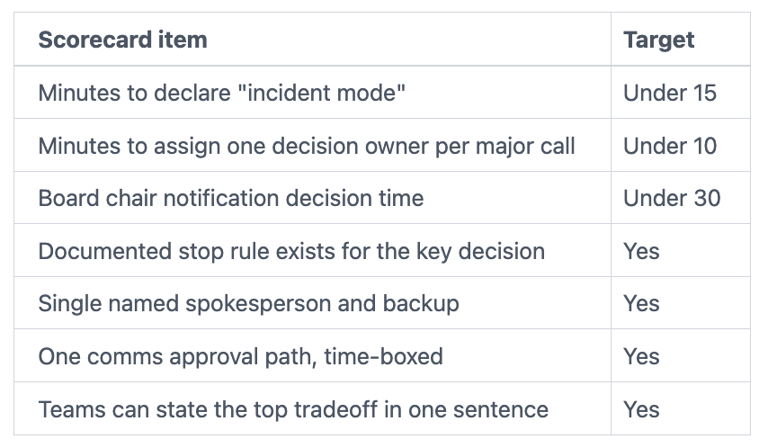
If the metrics do not move, the fixes were not real.
FAQs boards and executives ask before they commit to a tabletop simulation
Q: How much time does this take? A: You can surface the biggest decision gaps in 90 to 120 minutes.
Q: Who should attend? A: The real decision owners, plus the functions that can block execution (ops, legal, comms, security, finance).
Q: Is it confidential? A: It should be treated as sensitive. The point is to practice honestly, not perform.
Q: How is this different from a normal tabletop exercise? A: Many tabletops test awareness of a plan. Leadership Tabletop Simulations test decisions, timing, tradeoffs, and governance.
Q: How do we avoid it becoming theater? A: Require decisions in-session, then ship a short fix backlog with owners and dates.
Conclusion
Leadership Tabletop Simulations expose decision gaps fast because they recreate the conditions that break real teams: time pressure, incomplete facts, and cross-functional friction. In a single session, you can see where decision rights blur, where stop rules are missing, and where messaging splits. More importantly, you can turn that evidence into clear roles, usable thresholds, and faster alignment.
SageSims helps teams do the full loop: scenario design, facilitation that drives decisions, and debriefs that convert learning into shipped changes. Then you repeat, measure improvement, and build decision readiness you can defend to your board.
Pick one high-stakes scenario your organization cannot afford to improvise, then schedule a readiness conversation with SageSims using book a readiness call.